When to Charter Your Diving Cruise Indonesia: A Guide to Monsoons and Marine Migrations
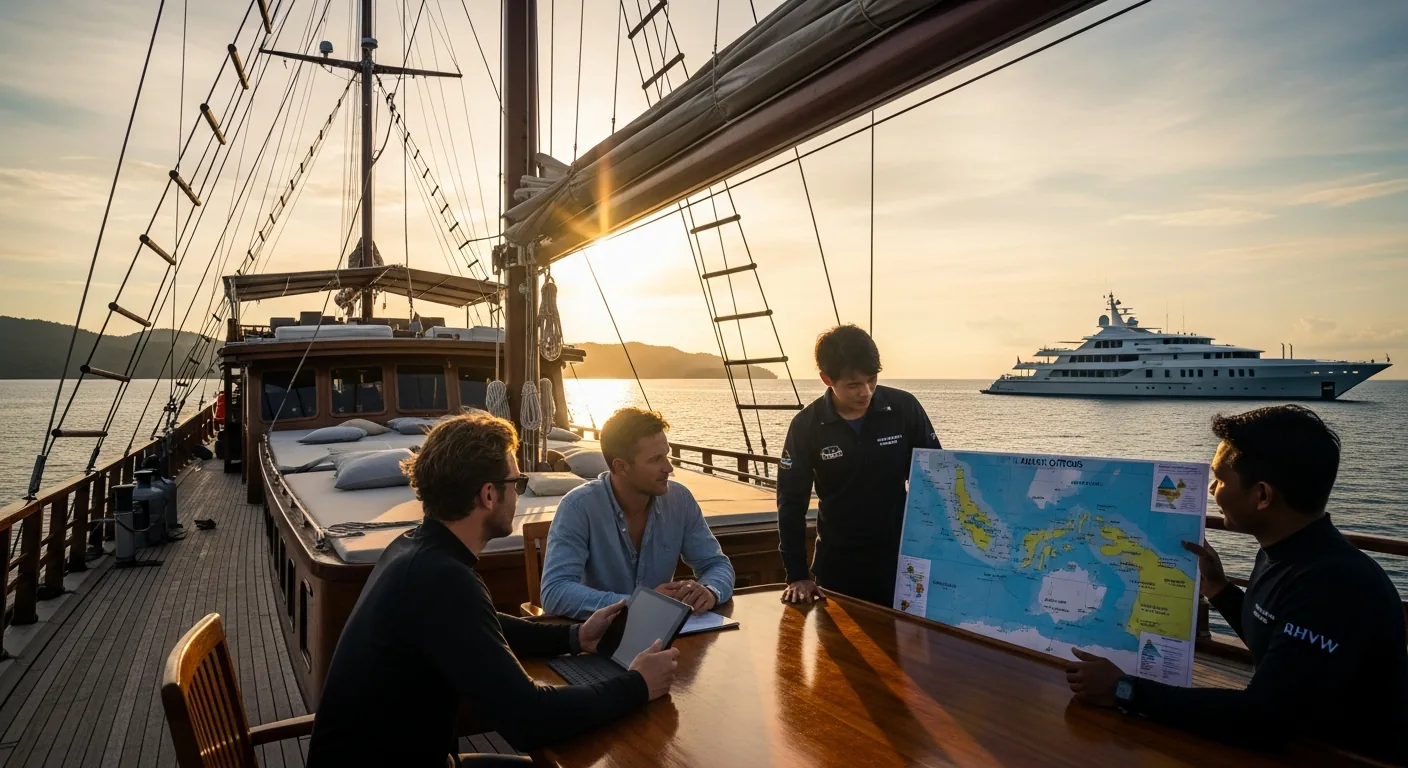
The teak deck is warm underfoot, the air thick with the scent of clove and saltwater. Below, the gentle creak of the phinisi’s rigging is the only sound that disturbs the glassy surface of the Banda Sea. Yet every seasoned diver on board knows this tranquility is deceptive. Beneath the hull, currents born halfway across the globe are funneling between volcanic islands, carrying with them the nutrients that fuel the planet’s most vibrant marine ecosystems. To be here, in this moment, is not a matter of luck, but of precise, deliberate timing.
For the discerning diver, planning an expedition across Indonesia’s 17,508 islands presents a complex logistical challenge disguised as a tropical reverie. The archipelago is not a singular entity but a series of distinct marine bioregions, each governed by the powerful, opposing rhythms of the Asian monsoons. To charter a `phinisi diving expedition` without a deep understanding of these climatic cycles is to risk rough seas, compromised visibility, and arriving at legendary dive sites a season too late for their signature encounters. The question is not simply where to go, but fundamentally, when. The answer lies in the wind, the water, and the science of the seasons.
The Monsoon Dichotomy: Indonesia’s Climatic Engine
The entire operational calendar for any serious `diving cruise indonesia` is dictated by two dominant weather systems: the dry Southeast Monsoon and the wet Northwest Monsoon. These are not merely patterns of rainfall; they are vast climatic engines that reverse wind directions, alter sea states, and, most critically, drive the nutrient upwellings that form the base of the marine food chain. Understanding this dichotomy is the first step in crafting a successful itinerary. See also: Home.
According to marine biologists from Indonesia’s Oceanographic Research Institute (LIPI), the seasonal winds create a phenomenon known as Ekman transport. During the Southeast Monsoon (roughly May to September), winds blowing from the southeast push surface water away from coastlines, allowing cold, nutrient-rich water from the deep to rise. This “upwelling” fuels plankton blooms, which in turn attract a cascade of marine life, from baitfish to manta rays and whales. The Northwest Monsoon (October to April) reverses this process, bringing calmer, warmer waters to some regions while rendering others inaccessible. For a `uhnw dive cruise`, aligning the vessel’s position with the favorable monsoon is the paramount concern. See also: Contact.
| Characteristic | Southeast Monsoon (Dry Season) | Northwest Monsoon (Wet Season) |
|---|---|---|
| Primary Period | May – September | October – April |
| Wind Direction | From Southeast/East | From Northwest/West |
| Key Diving Region | Komodo, Alor, Flores (Lesser Sunda Islands) | Raja Ampat, West Papua, Halmahera |
| General Conditions | Dry, sunny, strong winds can create chop | Humid, occasional rain squalls, calmer seas in protected areas |
Raja Ampat: The Northwest Monsoon’s Prime Time (October – April)
The “Four Kings” of West Papua, known as Raja Ampat, are best experienced when the Northwest Monsoon brings calm seas and placid weather. From October through April, the winds abate, rendering the vast area navigable and its legendary dive sites accessible. This is the peak season for a `raja ampat dive cruise`, with surface conditions that permit comfortable crossings between the Dampier Strait and the remote southern archipelago of Misool. During these months, water visibility frequently exceeds 30 meters, and temperatures hover at a consistent 28-30°C. See also: Diving Cruise Indonesia Premium.
The period is defined by staggering biodiversity. At sites like Cape Kri, marine biologist Dr. Gerald R. Allen famously identified a record 374 species of fish on a single dive. The changing monsoon currents trigger plankton blooms, attracting filter feeders in great numbers. At Magic Mountain or Manta Sandy, oceanic and reef manta rays congregate at cleaning stations, offering photographers and marine enthusiasts encounters. A private charter of a vessel such as the 10-guest Phinisi *Sequoia* for a 10-night expedition through Misool’s blue water mangroves and marine reserves typically requires a budget starting from $95,000 USD. The required Raja Ampat Marine Park permits, costing IDR 1,000,000 (approximately $65 USD) per person, are arranged by our expedition team as part of the charter service. See also: explore Raja Ampat Dive Cruise.
Komodo & The Lesser Sundas: The Southeast Monsoon’s Dominion (May – September)
As the winds shift in May, the focus of the Indonesian liveaboard fleet moves east to the Lesser Sunda Islands. The Southeast Monsoon brings dry, sunny weather to the Komodo National Park, creating the ideal conditions for a `premium diving liveaboard indonesia` experience. While the weather above is serene, the underwater environment is anything but. Komodo’s global reputation is built on the adrenaline of its currents. The straits between Komodo, Rinca, and Flores act as funnels for the Indonesian Throughflow, a massive volume of water moving from the Pacific to the Indian Ocean.
These powerful currents, while challenging, are precisely what make the diving so prolific. They sweep in nutrients, supporting a biomass that is visible on every dive. At Batu Bolong, a small rock pinnacle, the current splits, allowing divers to shelter in the lee while witnessing a theater of giant trevally, white-tip reef sharks, and Napoleon wrasse. In the cooler southern waters of the park, where upwellings can drop temperatures to a brisk 22-25°C (a 5mm wetsuit is advised), manta rays aggregate at feeding stations. The combination of exhilarating drift dives, macro critter hunts, and the requisite overland trek to see the Komodo dragons makes this a cornerstone of the Indonesian diving calendar. Expeditions here are best undertaken from June to late August for the most stable conditions.
The Banda Sea & Forgotten Islands: Navigating Inter-Monsoon Windows
For the expeditionary diver, the true jewels of the Indonesian archipelago are the “crossing” voyages through the Banda Sea and the Forgotten Islands. These itineraries are only possible during the brief, calm inter-monsoon periods: March to April and again from September to early November. During these windows, the seas are placid enough to undertake the long open-ocean passages required to reach these remote volcanic islands. This is the definition of a `uhnw dive cruise`, venturing far from established routes.
The allure is twofold: raw pelagic action and deep historical significance. These are the original Spice Islands, where fortunes were made and lost over nutmeg and mace. Today, the rewards are marine. At Manuk Island, an active volcano, vast congregations of sea snakes and circling barracuda are the norm. Further south, during the autumn transition, there is a high probability of encountering migrating Pygmy Blue Whales. The pinnacle encounter for many is the chance to witness schooling scalloped hammerheads in the deep, clear water off the volcanic pinnacles. A 12-night, full-charter expedition on a premier phinisi like the *Lamima* through this region can command upwards of $180,000 USD, reflecting the vessel’s capabilities and the complex logistics of provisioning for such a remote journey.
Understanding The Currents: The Indonesian Throughflow
No discussion of Indonesian diving is complete without addressing the currents. The primary force is the Indonesian Throughflow (ITF), the only current system on the planet that connects two major oceans. It funnels an average of 15 million cubic meters of water per second from the Pacific to the Indian Ocean, primarily through the deep channels of the Indonesian archipelago. This constant movement of water is the lifeblood of the Coral Triangle, transporting larvae, nutrients, and heat.
For the diver, this translates into dynamic, and at times demanding, conditions. It necessitates working with highly experienced guides—our team leaders carry a minimum of 5,000 logged dives specifically in these waters. Understanding how to dive these sites is critical for both safety and enjoyment. Key techniques include:
- Drift Dives: The most common profile, where divers use the current as a conveyor belt to travel along a reef wall, covering significant ground with minimal effort.
- Pinnacle Dives: At sites like Castle Rock in Komodo, the technique involves descending into the “split” or lee of the pinnacle, where the current is weakest, allowing for stationary observation of the pelagic life hunting in the main flow.
- Negative Entry: A rapid, simultaneous descent by the entire group to quickly get below any surface chop and into the main water column, often used in Komodo’s more exposed sites.
Aboard a Diving Cruise Indonesia Premium expedition, the dive plan for each site is meticulously briefed, accounting for the tide, moon phase, and real-time conditions to place divers in the optimal position.
Your Expedition, Timed to Perfection: A Comparative Calendar
| Region | Primary Season | Typical Weather | Avg. Water Temp | Expected Visibility | Signature Marine Encounters |
|---|---|---|---|---|---|
| Raja Ampat | October – April | Calm seas, occasional rain | 28-30°C (82-86°F) | 20-30+ meters | Manta rays, exceptional coral diversity, wobbegong sharks, vast fish schools. |
| Komodo National Park | May – September | Dry, sunny, can be windy | 22-28°C (72-82°F) | 15-25 meters | Komodo dragons, strong currents, manta rays, sharks, vibrant macro life. |
| Banda Sea Crossing | Mar-Apr & Sep-Nov | Calm, transitional weather | 27-29°C (81-84°F) | 25-40+ meters | Schooling hammerheads, sea snakes, migrating whales, pristine volcanic reefs. |
| Forgotten Islands | September – November | Calm, dry weather | 27-29°C (81-84°F) | 30-40+ meters | Exceptional visibility, untouched reefs, large pelagics, crocodile fish. |
Planning Your Charter: Actionable Steps for a Seamless Expedition
Timing is everything, but so is preparation. Securing the right vessel for the right season requires significant lead time, often 12 to 18 months in advance, particularly for peak season charters. Our process is designed to be meticulous and transparent, ensuring every detail aligns with your objectives. Here are the foundational steps to begin crafting your private Indonesian diving charter:
- Consult Our Expedition Planners: The initial conversation is critical. We discuss your group’s diving experience, specific interests (e.g., pelagic focus, macro photography, wreck exploration), and preferred travel window to align your desires with the seasonal possibilities.
- Review Vessel Specifications: Based on your party size and desired level of comfort, we propose a curated selection of phinisi yachts. We provide detailed specifications, crew profiles, and sample menus to ensure the vessel is a perfect match.
- Define Your Bespoke Itinerary: While we operate signature routes, no two charters are identical. We collaborate with you to build a day-by-day itinerary that can incorporate specific dive site requests, land excursions to visit the spice plantations of Banda Neira, or dedicated time for drone and underwater filming.
- Confirm All Logistics: Our Bali-based operations team manages the entire logistical chain. This includes all domestic flights and transfers, park permits, port clearances, and the provisioning of specific dietary requests, fine wines, or specialized dive equipment.
Consult an Expedition Specialist
The Indonesian archipelago offers a lifetime of diving, but the perfect expedition requires marrying personal ambition with oceanic rhythm. Our role is to provide the expert guidance necessary to navigate these complexities, ensuring your time on the water is flawless. Contact our planning office to begin the conversation about your private diving cruise in Indonesia.
Jalan Sunset Road No. 88, Kuta, Badung, Bali 80361
Phone: +62 811-3941-4563
Email: [email protected]